October update: read before using the September diagrams
Blizzard’s October notes: Tiger’s Fury and King of the Jungle were removed; Feral gained Shifting Power and Improved Shifting Power.
The diagrams and tooltip tables below preserve September build 1.60.1.69876. They are historical references; the former example allocations have been withdrawn. Check the current client and calculator before spending points.
Druid talents: choose the job before the points
This deep dive covers Balance, Feral Combat and Restoration. The best starting question is which activity and responsibility you want to prepare for. A talent that makes solo pulls easier can have less value when a tank controls the enemies; a later capstone cannot explain what an eleven-point character can do today.
| Tree | Main planning question |
|---|---|
| Balance | September Wrath–Starfire reference |
| Feral Combat | Cat and Bear share a tree, not identical priorities |
| Restoration | Spend globals where the party needs them |
Historical data: how to read the September diagrams
Talent positions, ranks and descriptions here use the 17 September Talents Forever export. Its current website identifies the source as beta client build 1.60.1.69876, and all 468 exported class talents are marked beta-derived. The export’s introductory readme still refers to demo transcription; this guide uses the per-talent beta records, not the older spellbook material. This is attributed community extraction, not RaidMuster gameplay testing or confirmation of final tuning.
Data credit: Chris Baldwin / Talents Forever, licensed CC BY 4.0. We have reorganised the data, drawn the reference maps and added analysis. Icons and game tooltip text belong to Blizzard Entertainment. The three illustrations are diagrams made from that data, not screenshots taken inside the beta.
Each tree below has a full illustrated map, selected talent details, practical trade-offs from September. The detail tables show the exported text at the talent’s maximum rank. Ability damage and healing numbers can refer to an exported spell rank; they are not level-60 performance predictions. “Changed” in a diagram includes wording or position changes, not necessarily a balance buff.
Rows require 0, 5, 10, 15, 20, 25 and 30 points already spent in that tree. An arrow also requires its named talent at maximum rank. With one point per level from 10, the opening level-20 cap gives 11 points: enough to enter row 3, not to reach row 4. Those historical point rules do not validate a current allocation.
Balance: September Wrath–Starfire reference
Balance’s beta export supports a Wrath–Starfire relationship through Eclipse, but does not contain the earlier snapshot’s Balance of Nature talent. Eclipse stores faster-Starfire opportunities after Wrath. Nature’s Grace is a separate short casting-speed effect after eligible criticals. Plan how those effects overlap without assuming the old alternating-school bonus still exists.
The former September caster example reduced Wrath time and cost, adds general damage-spell efficiency and critical chance, then unlocks Nature’s Splendor through Nature’s Majesty. Its duration changes also touch healing spells, which is useful context for a flexible levelling character. Later Moonkin Form prevents healing spells while active, and its party critical aura is exclusive with Leader of the Pack. A raid planner should count that shared benefit once.
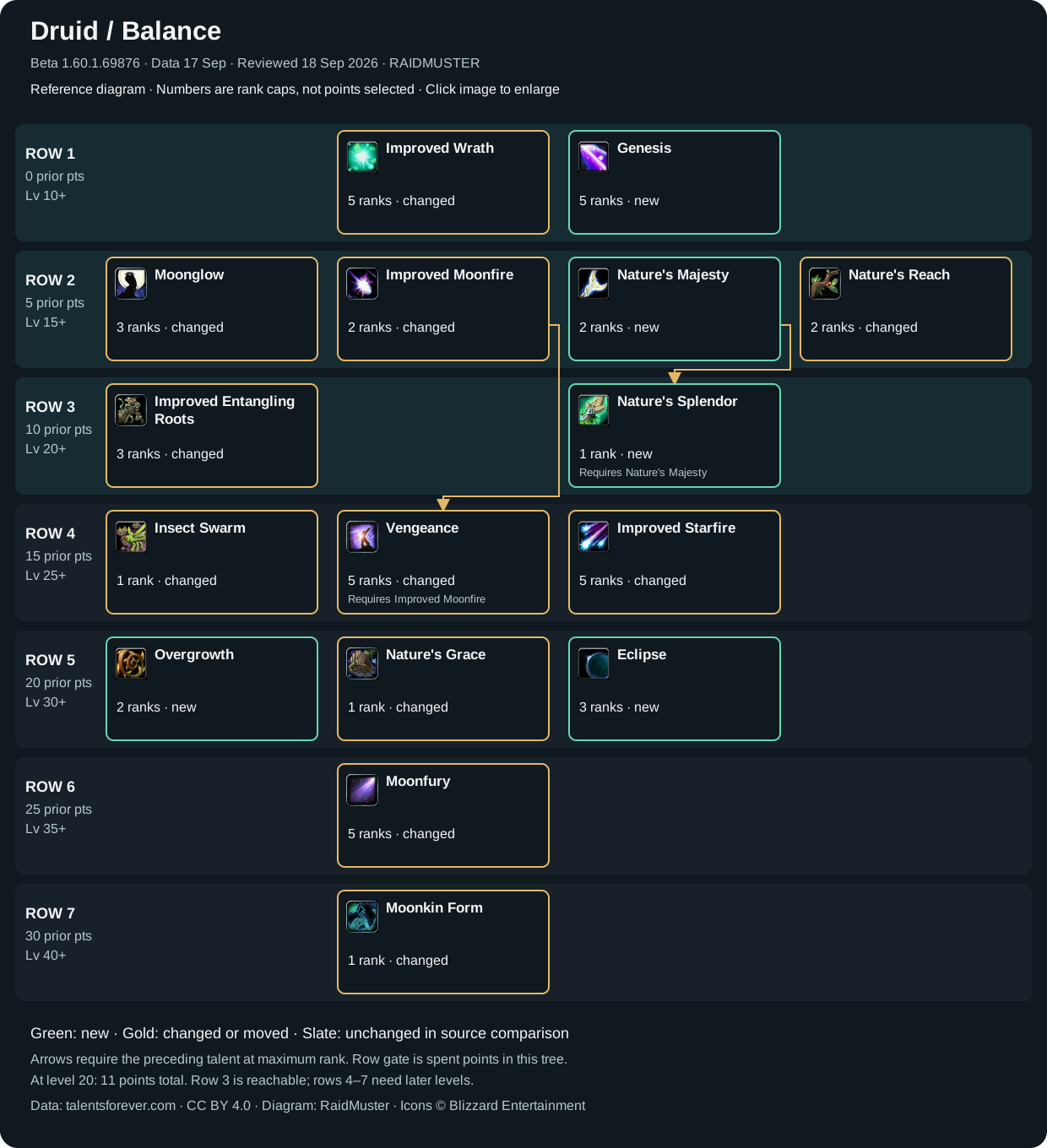
| Talent and rank | Exported effect | Unlock conditions |
|---|---|---|
| Moonglow (3/3) | Reduces the Mana cost of your damaging spells by 25%. | Row 2: 5 prior tree points |
| Nature's Splendor (1/1) | Increases the duration of your Moonfire and Rejuvenation spells by 3 sec, your Regrowth spell by 6 sec, and your Insect Swarm spell by 2 sec. | Row 3: 10 prior tree points; requires Nature's Majesty |
| Eclipse (3/3) | Your Wrath spell reduces the cast time of your next 2 Starfire spells by 0.50 sec. Stores up to 4 charges. Lasts 15 sec. | Row 5: 20 prior tree points |
| Nature's Grace (1/1) | All non-periodic spell criticals grace you with a blessing of nature, increasing your spellcasting speed and reducing your global cooldown by 10% for 3 sec. | Row 5: 20 prior tree points |
| Moonkin Form (1/1) | Transforms the Druid into Moonkin Form. While in this form, the armor contribution from items is increased by 360%, Omen of Clarity gains 100% increased chance to trigger, and all party members within 45 yards have their critical strike chance increased by 3%, exclusive with Leader of the Pack. The Moonkin cannot cast healing spells while shapeshifted. The act of shapeshifting frees the caster of Polymorph and Movement Impairing effects. | Row 7: 30 prior tree points |
September reference: Feral Combat
Feral’s two jobs need different answers to the same point budget. Cat values Energy, Combo Points and opportunities to maintain bleeds; Bear cares about incoming damage and dependable Rage for control. Primal Fury describes different critical-strike outcomes in each form. The September discussion included King of the Jungle and Tiger’s Fury; both are obsolete after the October update.
The former opening example is withdrawn. Record Cat or Bear intent, relevant equipment and the current allocation before volunteering for a second role. The September prerequisites shown below should not determine today’s spending order.
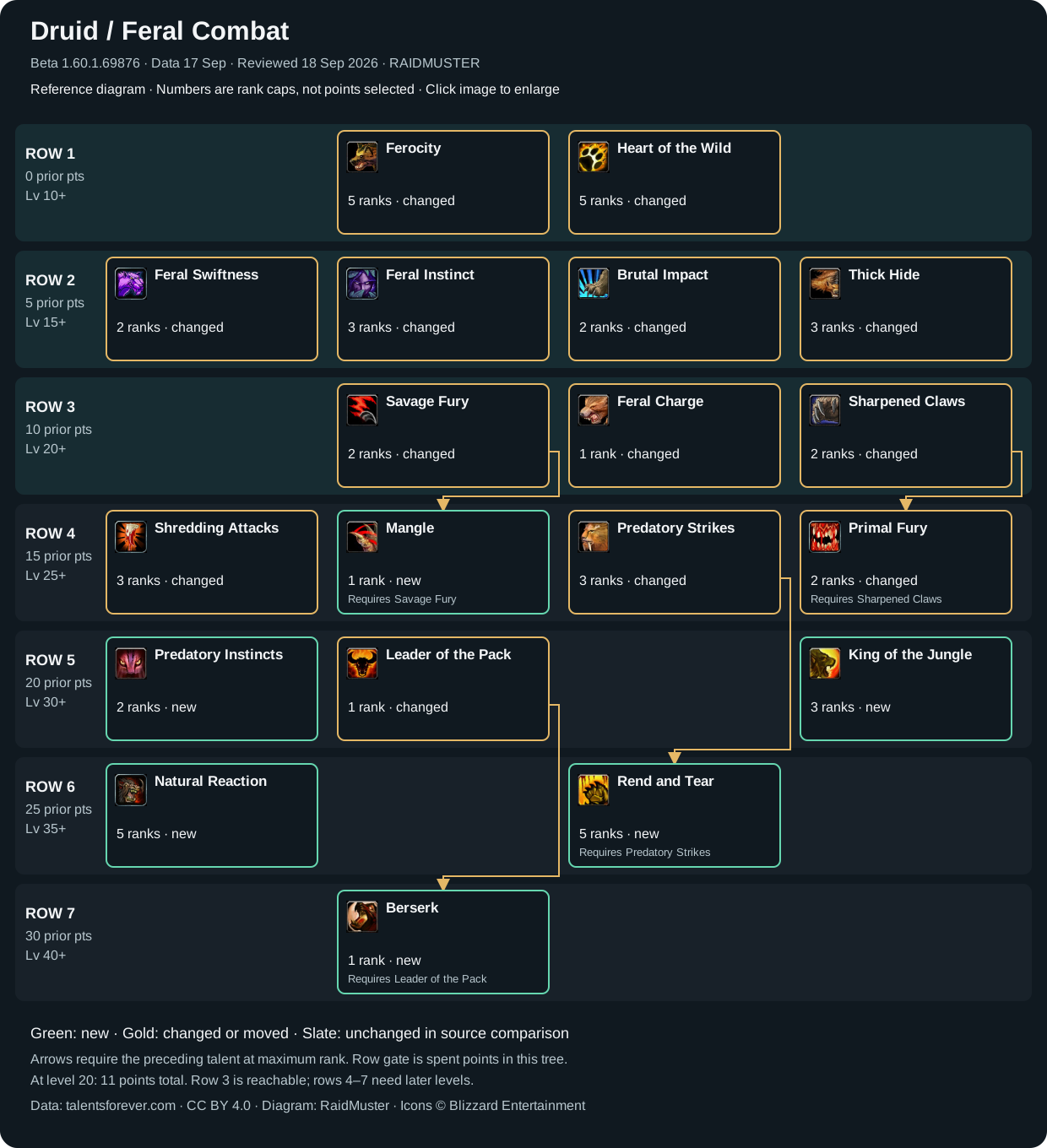
| Talent and rank | Exported effect | Unlock conditions |
|---|---|---|
| Heart of the Wild (5/5) | Increases your Intellect by 10%. In addition, while in Bear Form or Dire Bear Form your Stamina is increased by 20% and while in Cat Form your Strength is increased by 10%. | Row 1: 0 prior tree points |
| Mangle (1/1) | Mangle the target for 100% normal damage plus 26. | Row 4: 15 prior tree points; requires Savage Fury |
| Primal Fury (2/2) | Gives you a 100% chance to gain an additional 5 Rage any time you get a critical strike while in Bear Form or Dire Bear Form. In addition, your non-periodic critical strikes from Cat Form abilities that generate Combo Points have a 100% chance to add an additional Combo Point. | Row 4: 15 prior tree points; requires Sharpened Claws |
| Natural Reaction (5/5) | Increases your dodge chance by 5%, and gives you a 100% chance to gain 5 Rage each time you dodge. | Row 6: 25 prior tree points |
| Berserk (1/1) | Causes your Mangle ability to strike up to 3 targets, removes its cooldown, and increases the critical strike chance of your Combo Point-generating abilities by 100%. Clears and grants immunity to Fear effects for the duration. Lasts 15 sec. | Row 7: 30 prior tree points; requires Leader of the Pack |
Restoration: Spend globals where the party needs them
Restoration brings faster responses and party recovery at different depths. Gift of the Earthmother reduces the global cooldown of its listed spells; Swiftmend needs an existing Rejuvenation or Regrowth effect on the target. Nature’s Swiftness solves another problem by making the next Nature cast instant. These are complementary tools, not three copies of the same emergency heal.
The withdrawn September healer example took pushback protection and a shorter Healing Touch before Gift of the Earthmother, whose early relevance includes Rejuvenation. A character struggling more with mana could compare subsequent Reflection investment. Wild Growth is a later target-and-party heal with a range condition, not permission to assume every injured raid member receives it. Choose the initial recipient deliberately and measure useful healing alongside overhealing and mana.
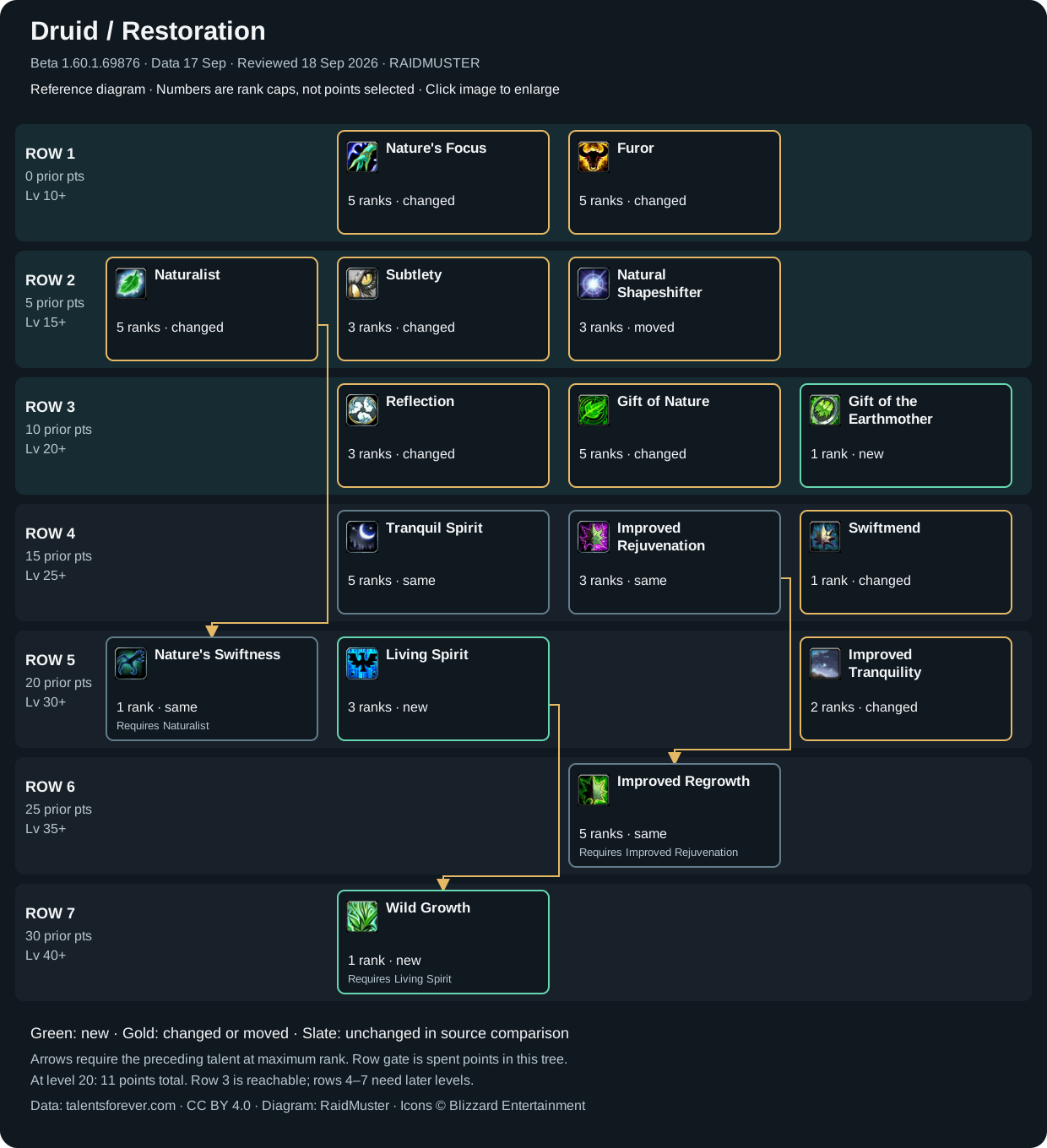
| Talent and rank | Exported effect | Unlock conditions |
|---|---|---|
| Reflection (3/3) | Allows 50% of your Mana regeneration to continue while casting. | Row 3: 10 prior tree points |
| Gift of the Earthmother (1/1) | Reduces the global cooldown by 0.5 seconds on your Rejuvenation, Swiftmend, and Wild Growth spells. | Row 3: 10 prior tree points |
| Swiftmend (1/1) | Instantly heals a target with an active Rejuvenation or Regrowth effect for an amount equal to the full duration of the periodic effect of one of those spells. | Row 4: 15 prior tree points |
| Nature's Swiftness (1/1) | When activated, your next Nature spell becomes an instant cast spell. | Row 5: 20 prior tree points; requires Naturalist |
| Wild Growth (1/1) | Heals the target and their party for 336 over 7 sec. Party members must be within 43 yards of target. The amount healed is applied quickly at first, and slows down as Wild Growth reaches its full duration. | Row 7: 30 prior tree points; requires Living Spirit |
Previous level-20 examples have been withdrawn
The former sequences were tied to the September export. Rebuild your intended allocation against the current client rather than copying the older instructions.
September reference: capstones and the hybrid trade-off
A 31-point main-tree commitment leaves 20 points elsewhere at the calculator’s level-60 budget of 51. It cannot include another tree’s 21-point talent. Conversely, stopping short of a capstone opens more secondary-tree investment, but loses the final interaction described above. Count the exact earlier talents you give up, not only the capstone name.
These are historical later-level references, not current allocation advice. Save a dated build in the Talents Forever calculator or cross-check the Wowhead Forever calculator. If either has changed since this article, compare the client build and prerequisite map before copying an older link.
| Tree | Final-row talent | Prerequisites | Point implication |
|---|---|---|---|
| Balance | Moonkin Form | 30 prior points | 31-point commitment; earliest level 40 with all points in this tree |
| Feral Combat | Berserk | 30 prior points; Leader of the Pack maxed | 31-point commitment; earliest level 40 with all points in this tree |
| Restoration | Wild Growth | 30 prior points; Living Spirit maxed | 31-point commitment; earliest level 40 with all points in this tree |
What your group needs to know
The reported Moonkin and Leader of the Pack effects are mutually exclusive, and both require their respective talent investment and form conditions. For a guild roster, record Balance, Cat, Bear or Restoration explicitly. Do not count one player as simultaneously filling a tank and healer vacancy.
How to compare two Druid allocations fairly
Keep the same character level, weapons, relevant spell ranks and target type while changing one allocation decision. Record time spent recovering as well as the successful fight. For a healer, note useful healing and mana; for a tank, loose enemies and incoming pressure; for damage, movement and setup time.
Write down the selected talent ranks, client build and whether the necessary condition actually occurred. A missed prerequisite, a dead pet or a target that never survived the setup is not a fair test of the later interaction. Distinguish an observed result from a tooltip expectation.
Check our dated beta known-issues guide and its official source before interpreting unexpected behaviour. Pet displays, class interactions and combat calculations have reported limitations. This historical discussion does not claim firsthand testing.
For guild planning, record the calculator link, intended role and selected utility alongside the character. Use RaidMuster’s roster management workflow to see how a group plan can be organised; this does not imply automatic import of talent-calculator links.