Shaman talents: choose the job before the points
This deep dive covers Elemental, Enhancement and Restoration. The best starting question is which activity and responsibility you want to prepare for. A talent that makes solo pulls easier can have less value when a tank controls the enemies; a later capstone cannot explain what an eleven-point character can do today.
| Tree | Main planning question |
|---|---|
| Elemental | Resource planning before the Lava Burst destination |
| Enhancement | Intellect and melee feed a mixed attack sequence |
| Restoration | Choose mana support and a useful healing rhythm |
Beta data, diagrams and how to read this guide
Talent positions, ranks and descriptions here use the 17 September Talents Forever export. Its current website identifies the source as beta client build 1.60.1.69876, and all 468 exported class talents are marked beta-derived. The export’s introductory readme still refers to demo transcription; this guide uses the per-talent beta records, not the older spellbook material. This is attributed community extraction, not RaidMuster gameplay testing or confirmation of final tuning.
Data credit: Chris Baldwin / Talents Forever, licensed CC BY 4.0. We have reorganised the data, drawn the reference maps and added analysis. Icons and game tooltip text belong to Blizzard Entertainment. The three illustrations are diagrams made from that data, not screenshots taken inside the beta.
Each tree below has a full illustrated map, selected talent details, practical trade-offs and an example allocation. The detail tables show the exported text at the talent’s maximum rank. Ability damage and healing numbers can refer to an exported spell rank; they are not level-60 performance predictions. “Changed” in a diagram includes wording or position changes, not necessarily a balance buff.
Rows require 0, 5, 10, 15, 20, 25 and 30 points already spent in that tree. An arrow also requires its named talent at maximum rank. With one point per level from 10, the opening level-20 cap gives 11 points: enough to enter row 3, not to reach row 4. Our example allocations are checked against these exported rules; validate them against your client before spending.
Elemental: Resource planning before the Lava Burst destination
Elemental’s deeper tree brings cast-time support and extra Lightning casts alongside Lava Burst. Lightning Overload’s additional cast has its own damage and threat wording; it is not simply another full-strength manual cast. Lava Burst receives a damage increase against a Flame Shock target in this export, rather than an instruction to assume a guaranteed critical strike.
The early example begins with cheaper casts, Fire support and some Shock cooldown reduction, then reaches Elemental Focus. A Lightning-heavy player should compare that Fire investment with their actual spell usage. Later, Elemental Fury unlocks Call of Thunder, which in turn precedes Elemental Alacrity. Budget for that chain before planning a split-tree build. Track drinking and interrupted casts alongside damage when deciding what the group gains.
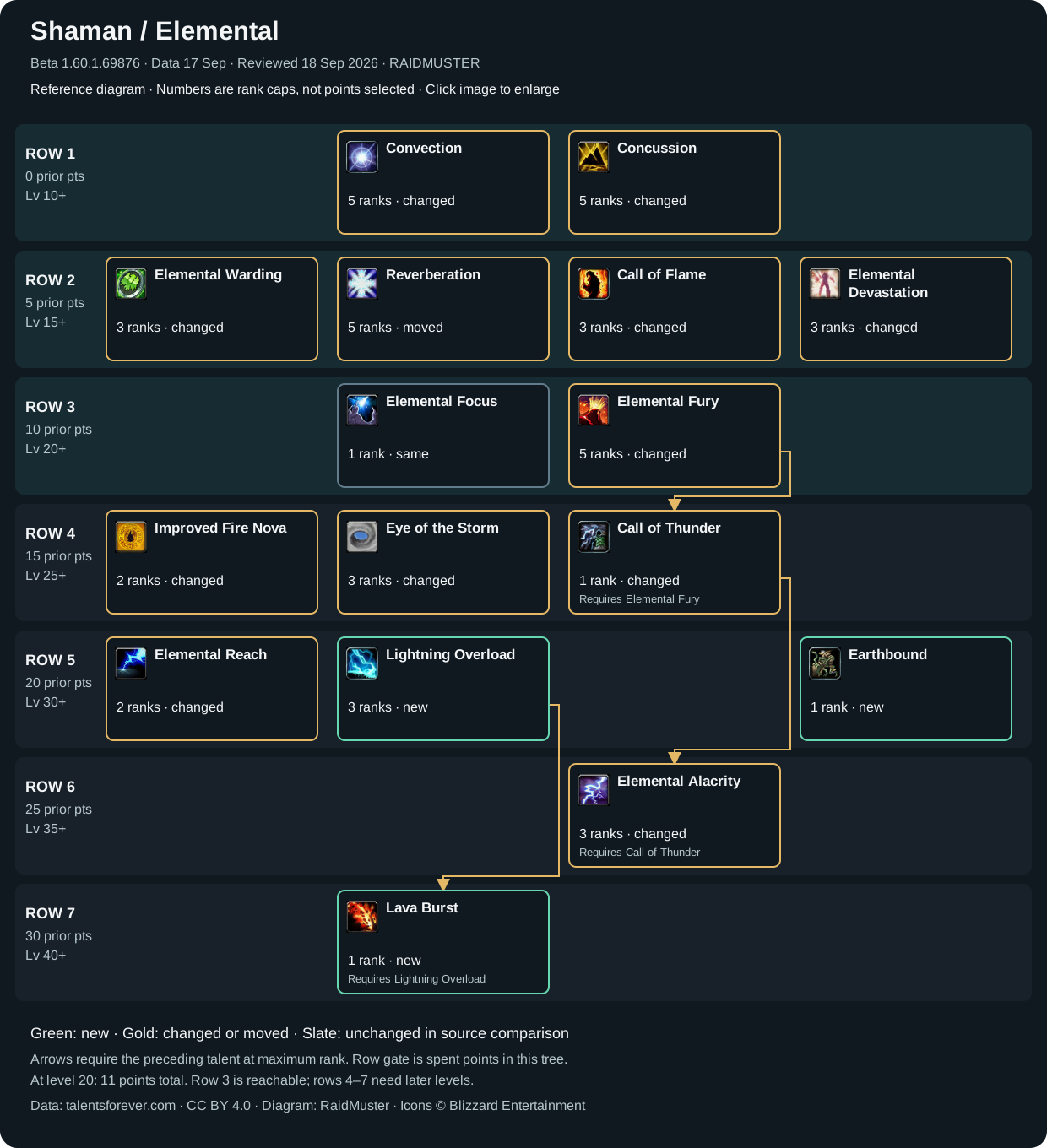
| Talent and rank | Exported effect | Unlock conditions |
|---|---|---|
| Elemental Focus (1/1) | Gives you a 10% chance to enter a Clearcasting state after casting any Fire, Frost, or Nature damage spell. The Clearcasting state reduces the mana cost of your next damage spell by 100%. | Row 3: 10 prior tree points |
| Elemental Fury (5/5) | Increases the critical strike damage bonus of your Searing and Magma Totems and your Fire, Frost, and Nature spells by 100%. | Row 3: 10 prior tree points |
| Lightning Overload (3/3) | Gives your Lightning Bolt and Chain Lightning spells a 10% chance to cast a second, similar spell on the same target at no additional cost that causes half damage and no threat. | Row 5: 20 prior tree points |
| Elemental Alacrity (3/3) | Reduces the cast time of your Lightning Bolt, Chain Lightning, and Lava Burst spells by 0.50 sec. | Row 6: 25 prior tree points; requires Call of Thunder |
| Lava Burst (1/1) | You hurl molten lava at the target, dealing 106 to 134 Fire damage. If your Flame Shock is on the target, Lava Burst deals 20% increased damage. | Row 7: 30 prior tree points; requires Lightning Overload |
Enhancement: Intellect and melee feed a mixed attack sequence
Enhancement connects Intellect to Attack Power through Mental Dexterity and later to spell damage and healing through Mental Quickness. Stormstrike sets up an eligible follow-up spell, while Maelstrom Weapon specifically reduces the cast time and cost of Lightning Bolt in this snapshot. These conditions make the sequence more precise than simply alternating any melee attack with any spell.
The opening example supports critical strikes and Intellect scaling, takes movement utility, and ends with cheaper Shock and Lightning Shield spells. It does not yet reach Stormstrike. Later Spirit Weapons changes threat differently depending on Rockbiter, so check the active weapon imbue before joining as damage. Defensive talents and threat wording alone do not establish an intended or proven tank role; a group should not infer that assignment from the tree name.
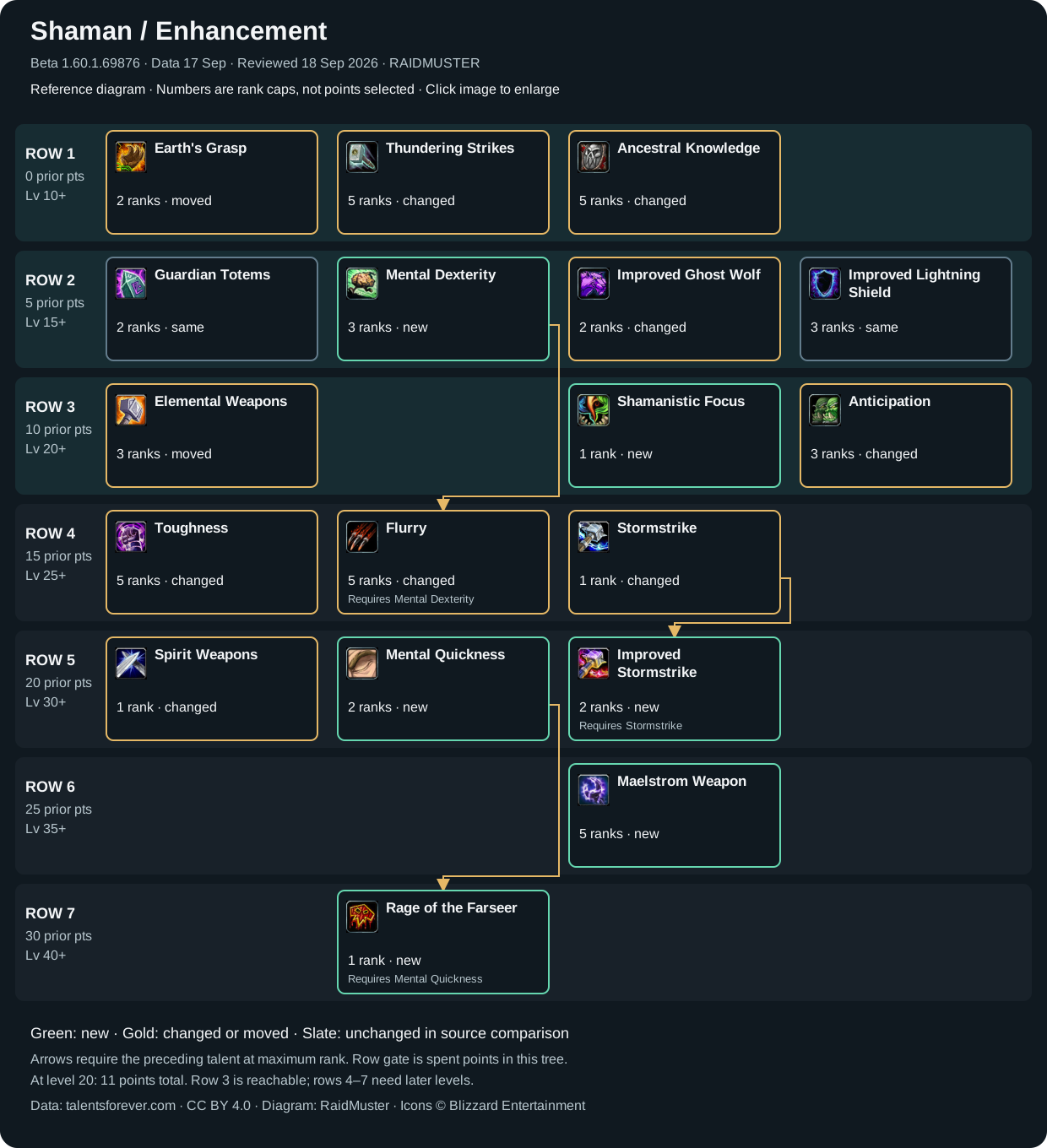
| Talent and rank | Exported effect | Unlock conditions |
|---|---|---|
| Mental Dexterity (3/3) | Increases your Attack Power by an amount equal to 100% of your Intellect. | Row 2: 5 prior tree points |
| Stormstrike (1/1) | Instantly strike for normal weapon damage and increase the damage you deal to the target with your next Lightning Bolt, Chain Lightning, or Earth Shock spell by 20% for 12 sec. | Row 4: 15 prior tree points |
| Spirit Weapons (1/1) | Gives a chance to parry enemy melee attacks, reduces all threat generated by your attacks by 30% while Rockbiter Weapon is not active, and increases all threat generated by 30% while Rockbiter Weapon is active. | Row 5: 20 prior tree points |
| Maelstrom Weapon (5/5) | When you deal damage with a melee attack, you have a chance to reduce the cast time and Mana cost of your next Lightning Bolt spell by 20%. Stacks up to 5 times. Lasts 30 sec. | Row 6: 25 prior tree points |
| Rage of the Farseer (1/1) | Increases your melee attack speed and spell casting speed by 30% for 25 sec. | Row 7: 30 prior tree points; requires Mental Quickness |
Restoration: Choose mana support and a useful healing rhythm
Restoration separates passive casting-time regeneration from resources returned by Water Shield and Mana Tide. Water Shield has charges and a limit on activation frequency; it is not an unlimited return on every damage event or healing critical. Mana Tide appears before the final row, so later hybrid planning should count its actual point gate rather than importing a Classic allocation.
The opening healer example takes faster Healing Wave, regeneration and some cheaper healing before Water Shield. It gives up early totem-cost reductions, which may matter if you reposition frequently. Deeper Riptide supplies immediate and periodic healing and improves Chain Heal casts directed at its target. That makes the starting target important: evaluate who needs recovery and who can benefit from the follow-up, rather than using the sequence purely because both buttons are available.
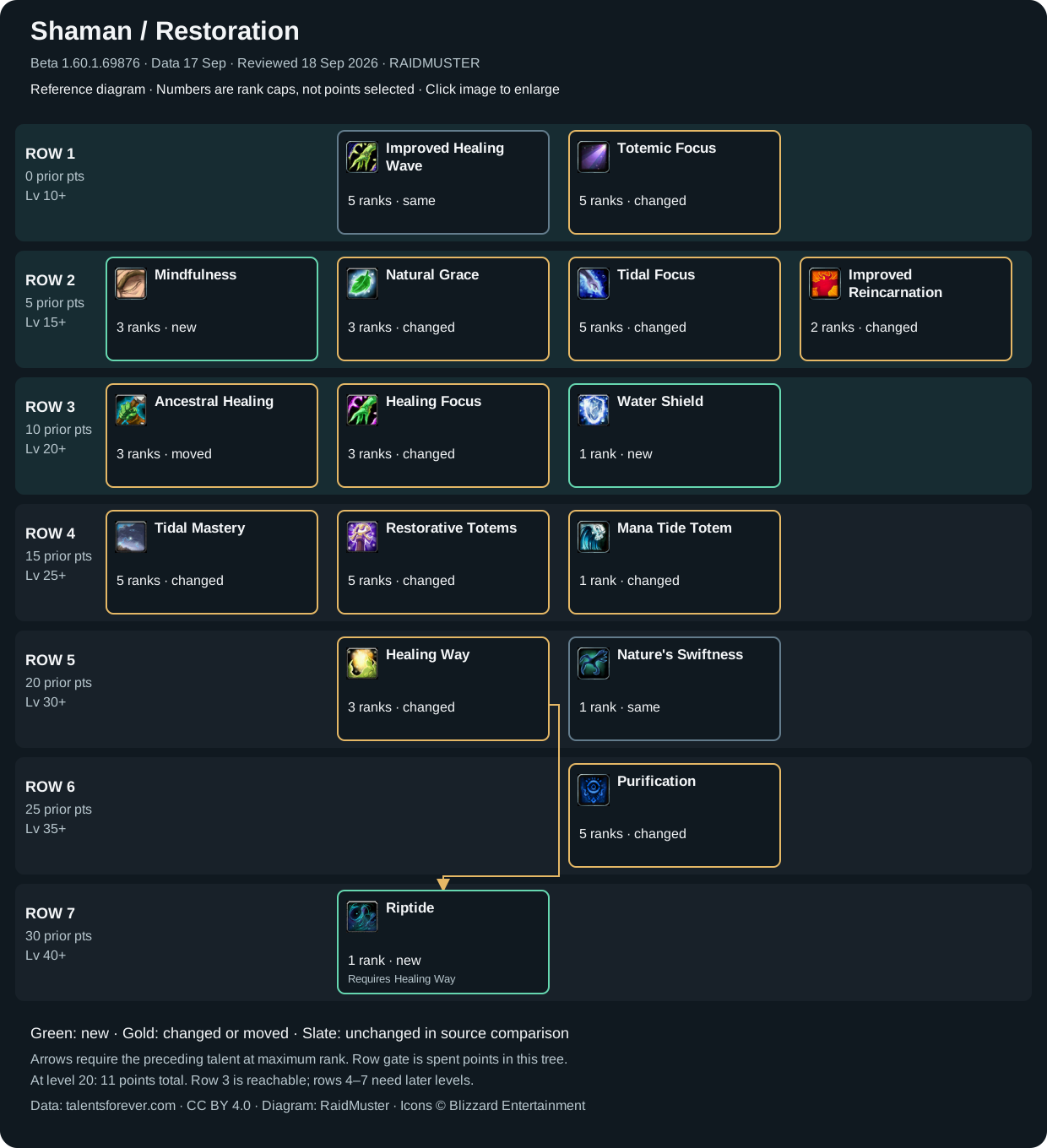
| Talent and rank | Exported effect | Unlock conditions |
|---|---|---|
| Mindfulness (3/3) | Allows 50% of your Mana regeneration to continue while casting. | Row 2: 5 prior tree points |
| Water Shield (1/1) | The caster is surrounded by 3 globes of water. When a spell, melee, or ranged attack hits the caster or when one of the caster's healing spells gets a critical result, 2% of maximum mana is restored to the caster, expending one water globe. Only one globe will activate every few seconds. Lasts 10 min. Only one Elemental Shield can be active on the Shaman at any one time. | Row 3: 10 prior tree points |
| Mana Tide Totem (1/1) | Summons a Mana Tide Totem with 5 health at the feet of the caster for 12 sec that restores 88 mana every 3 seconds to group members within 30 yards. | Row 4: 15 prior tree points |
| Nature's Swiftness (1/1) | When activated, your next Nature spell with a casting time less than 10 sec. becomes an instant cast spell. | Row 5: 20 prior tree points |
| Riptide (1/1) | Heals a friendly target for 485 to 533, an additional 445 over 15 sec, and increases the effectiveness of your Chain Heal casts directly on that target by 25%. | Row 7: 30 prior tree points; requires Healing Way |
Level-20 example builds: exactly 11 points
These are complete early allocations in spending order, not proven best builds. Choose one row; do not combine the three allocations. The tree discussions above explain their different purposes and opportunity costs. Each allocation respects the exported row gates, prerequisite ranks and eleven-point budget.
Only points are being validated here. Confirm access to the relevant spells, equipment and client implementation before testing the sequence. A calculator allocation does not prove an ability is working correctly in the current beta.
| Tree | Spend in this order | Budget |
|---|---|---|
| Elemental | Level 10–14: Convection 5/5; Level 15–17: Call of Flame 3/3; Level 18–19: Reverberation 2/5; Level 20: Elemental Focus 1/1 | 11 points; all other trees 0 |
| Enhancement | Level 10–14: Thundering Strikes 5/5; Level 15–17: Mental Dexterity 3/3; Level 18–19: Improved Ghost Wolf 2/2; Level 20: Shamanistic Focus 1/1 | 11 points; all other trees 0 |
| Restoration | Level 10–14: Improved Healing Wave 5/5; Level 15–17: Mindfulness 3/3; Level 18–19: Tidal Focus 2/5; Level 20: Water Shield 1/1 | 11 points; all other trees 0 |
Later builds: capstones and the hybrid trade-off
A 31-point main-tree commitment leaves 20 points elsewhere at the calculator’s level-60 budget of 51. It cannot include another tree’s 21-point talent. Conversely, stopping short of a capstone opens more secondary-tree investment, but loses the final interaction described above. Count the exact earlier talents you give up, not only the capstone name.
These are later-level planning options, not opening-beta allocations. Save a dated build in the Talents Forever calculator or cross-check the Wowhead Forever calculator. If either has changed since this article, compare the client build and prerequisite map before copying an older link.
| Tree | Final-row talent | Prerequisites | Point implication |
|---|---|---|---|
| Elemental | Lava Burst | 30 prior points; Lightning Overload maxed | 31-point commitment; earliest level 40 with all points in this tree |
| Enhancement | Rage of the Farseer | 30 prior points; Mental Quickness maxed | 31-point commitment; earliest level 40 with all points in this tree |
| Restoration | Riptide | 30 prior points; Healing Way maxed | 31-point commitment; earliest level 40 with all points in this tree |
What your group needs to know
Mana Tide Totem is a talent investment with a group range to respect. Earthbound is a selected control interaction. Coordinate who benefits from the totem and where the group stands; the Shaman class name alone does not confirm either talent.
How to compare two Shaman allocations fairly
Keep the same character level, weapons, relevant spell ranks and target type while changing one allocation decision. Record time spent recovering as well as the successful fight. For a healer, note useful healing and mana; for a tank, loose enemies and incoming pressure; for damage, movement and setup time.
Write down the selected talent ranks, client build and whether the necessary condition actually occurred. A missed prerequisite, a dead pet or a target that never survived the setup is not a fair test of the later interaction. Distinguish an observed result from a tooltip expectation.
Check our dated beta known-issues guide and its official source before interpreting unexpected behaviour. Pet displays, class interactions and combat calculations have reported limitations. Our allocations are planning suggestions, not claims of firsthand testing.
For guild planning, record the calculator link, intended role and selected utility alongside the character. Use RaidMuster’s roster management workflow to see how a group plan can be organised; this does not imply automatic import of talent-calculator links.